
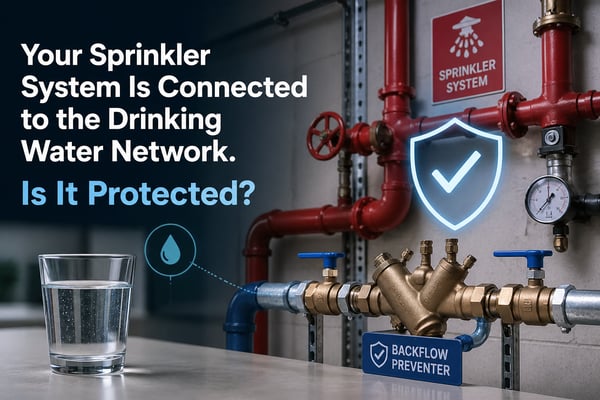
This is not a hypothetical scenario. It has happened. And without the right protection, it can happen again.
The Short Answer
Activating or testing a sprinkler system without a correctly installed backflow preventer can cause contaminated water to seep back into the municipal drinking water network. Water from sprinkler pipes is typically classified as liquid category 3 or 4 — meaning it can contain dissolved substances from the pipes, corrosion particles or antifreeze.
Norwegian law prohibits this. And many older systems still lack adequate protection.
What Is a Backflow Preventer — and Why Is It Necessary?
The Mechanism Nobody Tells You About
Sprinkler systems are connected to the municipal drinking water network. Under normal conditions, pressure in the network is higher than in the sprinkler system, and water flows in one direction. But if negative pressure develops in the drinking water network — due to a pipe burst, high water demand or flow testing — the direction can reverse. Water from the sprinkler system can then be drawn into the network and reach other connected users.
The backflow preventer is the barrier that stops this. Without it, the sprinkler control valve is the only barrier between your sprinkler system and the tap water of everyone on the same network.
What Does Water From a Sprinkler System Actually Contain?
Water that has been standing in sprinkler pipes is no longer clean drinking water. NS-EN 1717 classifies liquids into five categories:
| Category | Description |
|---|---|
| 1 | Clean drinking water |
| 2 | Harmless, but altered taste or appearance |
| 3 | Chemicals, heavy metals, pipe materials |
| 4 | Toxic or carcinogenic substances |
| 5 | Pathogens — wastewater |
Water from sprinkler systems is now typically classified as category 3 or 4, depending on standing time and whether antifreeze has been added. Category 4 requires the most stringent protection: a BA valve with a controllable reduced-pressure zone.
Six Ways Sprinkler Systems Can Degrade Drinking Water Quality
Pipe bursts or high demand create backflow conditions. Risk is highest during flooding or extreme weather events.
Large-diameter pipes carry low daily flow. Stagnant water promotes bacterial growth and declining quality.
High-velocity flow during testing dislodges internal pipe lining and suspends it in the water supply.
Sudden valve opening creates pressure waves that can exceed pipe ratings, causing bursts or blowouts.
Pressure below the vapour point creates collapsing bubbles that damage pump systems over time.
Metal ions and rust accumulate in stagnant sprinkler water and can enter the supply during backflow.
What Regulations Require
"It is prohibited to contaminate drinking water." The prohibition applies to all activities from the catchment area to the point of use — and to all users, not just the water utility.
Sprinkler systems must have adequate protection against backflow. The water utility may impose limits on maximum flow rates during testing.
Backflow preventers must be inspected and replaced if necessary every three years. Manufacturers additionally recommend annual servicing.
What Norwegian Municipalities Report Today
RISE Fire Research contacted the water and wastewater authorities in four major Norwegian cities in 2019:
- Bergen Aware of two serious incidents where sprinkler water containing additives entered the drinking water supply.
- Trondheim Increased focus on compliance after 2015. No known incidents reported.
- Stavanger Actively focused on backflow protection requirements since 2011.
- Oslo Follows up through inspections and orders older systems to install backflow protection. Notes that leakage may contribute to "diffuse contamination" that is almost impossible to trace to a specific source.
None of the municipalities maintain a national register of contamination incidents. The true scale of the problem is unknown.
The Most Concerning Gap
There are currently no ongoing monitoring points to detect water quality upstream of the backflow valve between the three-yearly inspections. A faulty valve can exist undetected for up to three years — and in the meantime, the sprinkler control valve is the only barrier protecting the drinking water supply.
How Firemesh Helps Close This Gap
Firemesh cannot replace the physical inspection of the backflow preventer — that requires hands-on inspection and potential replacement. But the system can:
- Automatically remind you when the three-year inspection deadline is approaching
- Log that the inspection has been completed and document it digitally
- Alert you if the deadline is exceeded without a recorded inspection
- Give building owners and managers complete visibility of every checkpoint, including backflow prevention status
Regulations set the requirements. Firemesh ensures no deadline is missed.
→ See how Firemesh tracks backflow preventer deadlinesFrequently Asked Questions
Can sprinkler systems actually contaminate drinking water?
Yes. Bergen's water and wastewater authority is aware of two documented incidents. There are likely more, but no national statistics exist to confirm the full picture.
What category is sprinkler water classified as?
Typically category 3 or 4 under NS-EN 1717. Category 3 involves dissolved chemicals and heavy metals from the pipes. Category 4 can include antifreeze, which is directly hazardous to health. Both require more stringent protection than many older systems currently have.
Am I required to install a backflow preventer?
Yes. The Drinking Water Regulation Sections 4 and 12 impose requirements on all connected users. The municipality can order installation during an inspection — even on older systems that predate the requirement.
How often must the backflow preventer be inspected?
Every three years under NS-EN 12845, Section 20.3.5.3. Manufacturers recommend annual servicing in addition to the mandatory three-year inspection.
What happens if the backflow preventer fails between inspections?
There is currently no automatic alert mechanism. The fault can go undetected for up to three years. This is precisely the gap Firemesh addresses by giving building owners digital visibility and automated deadline tracking.
How does Firemesh help with backflow preventer compliance?
Firemesh tracks the three-year inspection deadline automatically, logs completion digitally and alerts the responsible person if the deadline is exceeded without a recorded inspection — so nothing falls through the cracks between manual inspection cycles.
Source: RISE Fire Research, report A19 20412:1 "Requirements for inspection and reliability of sprinkler systems", 2019. Commissioned by Firemesh AS.