
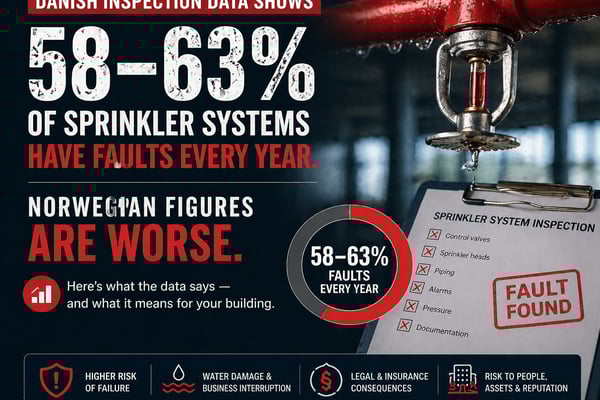
The figures come from systematic inspection data — not worst-case scenarios.
The Short Answer
Denmark's DBI inspects hundreds of sprinkler systems every year and consistently finds that more than half have recorded faults — and that 2.5–6.6% have deficiencies so serious that the system cannot be expected to work in a fire. In Norway, the data is thinner — but what we do know is worse than in Denmark. An OFAS report found that only 8% of Norwegian systems met the minimum requirements.
This is not a criticism of the industry. It is statistics — and it very likely applies to the system in your building too.
What Danish Inspection Data Actually Shows — One Level Deeper
Denmark's DBI (Danish Institute of Fire and Security Technology) operates one of the most systematic inspection regimes in Scandinavia. The figures year on year are strikingly consistent:
| Year | Critical faults — system not operational | Systems with any fault |
|---|---|---|
| 2007 | 2.6% | 61.1% |
| 2008 | 2.5% | 63.2% |
| 2009 | 5.0% | 59.0% |
| 2010 | 6.6% | 60.3% |
| 2011 | 6.0% | 58.5% |
| 2015 | 2.4% | 58.7% |
| 2016 | 3.2% | 58.4% |
What Does a "Critical Fault" Mean?
The Danish system classifies deficiencies into three categories, each with a defined consequence:
| Category | Severity | Deadline |
|---|---|---|
| A | System is not operational | Approval withdrawn immediately |
| B | Part of the system is not operational | Remedied within 2 months |
| C | Faults that gradually undermine protection | Remedied within 12 months |
In Norway, no equivalent sanctions mechanism exists. Faults can remain unremedied without consequence.
Norwegian Figures: What We Know — and What We Don't
A 2012 thesis reviewed 30 inspection reports from the ESS database and found 46 deficiencies relating to rooms without sprinkler coverage, 46 relating to insufficient sprinkler density, and 67 relating to incorrect spacing between heads and walls.
The RISE report notes that no significant changes in inspection practice have occurred since the OFAS review in 2003.
Where Do the Faults Sit?
From DBI inspection data for 2015 and 2016, the breakdown by fault category:
| Fault category | 2015 | 2016 |
|---|---|---|
| Operation, control and maintenance | 26.1% | 24.9% |
| Building fabric | 20.8% | 19.4% |
| Pipe installation | 15.5% | 16.5% |
| Pumps | 12.0% | 12.0% |
| Alarm valves | 6.0% | 7.0% |
The single largest category — operation, control and maintenance — is directly linked to inadequate inspection. These are faults that develop and grow between inspections.
What Happens in Practice When a System Fails?
OFAS describes the real-world consequences for each major fault type:
The system receives no water when it activates. High probability of total loss in a fire.
The system cannot deliver enough water. Dramatically increased probability of total loss.
The fire develops too fast. The system cannot extinguish or control it.
A fire in the unsprinklered area overwhelms the system when it spreads into the protected zone.
Nobody knows whether the system is capable of doing its job. Insurance cover may be voided.
The evaluation of the BASA building fire documented that inadequate maintenance of the sprinkler system directly contributed to the building being completely destroyed. This is not an isolated incident. It is a symptom of a systemic problem.
Why Are Faults Not Being Fixed?
Research into Norwegian conditions identifies five structural reasons:
- Insufficient training among those carrying out inspections
- Confusion over responsibility — many building owners do not know what they are accountable for
- Lack of understanding of consequences — faults do not feel dangerous in day-to-day operations
- Weak internal control systems without routines for learning from deficiencies
- Absent sanctions — insurance premiums are not increased, and enforcement notices are rarely issued
Unlike Denmark, where systems lose approval if category A faults remain unremedied, no equivalent mechanism exists in Norway.
How Firemesh Changes the Incentive Structure
Firemesh is built to fill precisely the gap that research identifies: faults that develop between inspections, and deficiencies that are never followed up because nothing forces action.
- Continuous monitoring detects faults that arise after the last inspection — not only at the next one
- Immediate alerts to the responsible person and their designated deputy
- Automatic logging that documents all activity digitally
- Insurance integration — the system can notify the insurer if deficiencies are not remedied within a set deadline
That is the mechanism missing from the current Norwegian system — and it is the mechanism Firemesh delivers.
→ See how Firemesh monitors your systemFrequently Asked Questions
Are Norwegian sprinkler systems worse than Danish ones?
Based on available data: probably yes. Norwegian OFAS figures are dramatically worse, and the sanctions regime is far weaker than Denmark's structured approval system.
What is a category A fault?
A critical deficiency that makes the system non-operational in a fire. In Denmark, approval is withdrawn immediately. In Norway, nothing happens automatically.
Can insurance be reduced or denied due to poor maintenance?
Yes. Inadequate maintenance provides grounds for reducing or denying an insurance claim. Missing documentation makes this outcome significantly more likely.
What is the most common type of fault?
Faults related to operation, control and maintenance — over 25% of all recorded faults in Danish data. These are directly linked to insufficient inspection and follow-up.
What does Firemesh do about deficiencies?
It alerts immediately, logs automatically, and can escalate to the insurer if deficiencies are not followed up within the agreed timeframe — creating the accountability mechanism that currently does not exist in Norway.
What does it mean that 60% of Norwegian systems did not correct all deficiencies?
That faults were identified but nobody followed up. Without sanctions or automated escalation, there is no mechanism to ensure deficiencies are actually closed.
Source: RISE Fire Research, report A19 20412:1 "Requirements for inspection and reliability of sprinkler systems", 2019 / DBI Danish Institute of Fire and Security Technology. Commissioned by Firemesh AS.