
The answer comes down to one simple question: when was it last checked?
The Short Answer
Well-maintained sprinkler systems work in 90–99% of fire incidents. But in 73% of cases where sprinklers fail to activate, the reason is that the system was switched off — not a technical fault. That is a failure routine inspection would almost always have caught.
The reliability of your sprinkler system is not primarily a question of technology. It is a question of process.
What the Research Actually Shows — One Level Deeper
Why a Single Reliability Figure Is Misleading
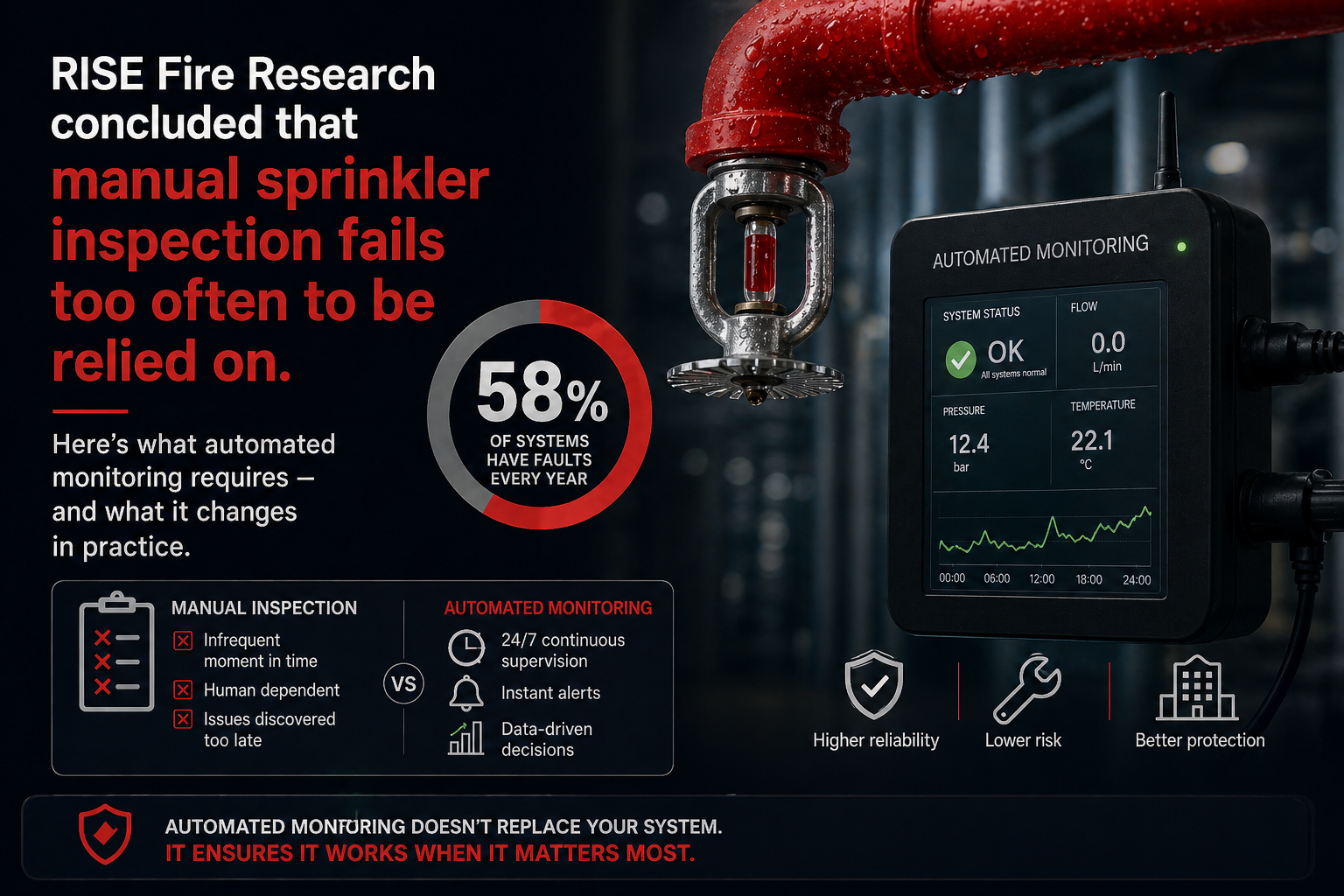
Sprinkler reliability statistics are notoriously difficult to compare. A review conducted by RISE Fire Research concluded that studies in this field "cannot be used to provide a general picture of sprinkler systems' historical or future reliability" — because definitions, data collection methods and analytical quality vary so widely.
To understand the numbers, you need to know what is being measured:
| Term | What It Measures |
|---|---|
| System stability | Does the system deliver water when it should? |
| Reliability | Does the system affect the fire as intended, given that water is delivered? |
| Effectiveness | The combination of both — did it work overall? |
Many studies conflate these terms, producing artificially high or low figures. Always check which metric is being cited before drawing conclusions.
What the Best Studies Show
3,299 fires analysed
After excluding cases where non-activation was clearly caused by other factors, the study concluded reliability above 99% for systems where activation was genuinely expected. Without exclusions: 81.5% activated.
NFPA — U.S. Experience with Sprinklers (2017)
92% of systems activated as they should. Of those, 96% performed effectively.
Overall effectiveness: 88%
Independent review of incident data
System stability: 95 ± 1.6% · Reliability: 90 ± 4.7% · Overall effectiveness: 86 ± 4.6%
The One Statistic You Should Remember
A contractor working on the system. A test that was never reconnected. An incident that occurred between two weekly inspections. Seven times out of ten, that is all it takes.
This is not an argument for better technology. It is an argument that a seven-day inspection interval is too long.
| Reason for failure to activate | Share |
|---|---|
| System switched off | 73 ± 23% |
| Manual intervention during the fire | 15 ± 4% |
| System unsuitable for the building's fire risk | 14 ± 10% |
| Insufficient maintenance | 10 ± 5% |
When a System Activates but Still Fails to Work
Even when sprinklers activate, the response can fall short. Reasons why systems activate but do not perform effectively:
| Reason | Share |
|---|---|
| Water did not reach the fire | 39 ± 14% |
| Insufficient water available | 32 ± 30% |
| Unsuitable system | 20 ± 14% |
| Manual intervention | 6 ± 3% |
| Insufficient maintenance | 6 ± 2% |
| Damaged components | 5 ± 2% |
The two largest categories — water not reaching the fire, and insufficient water — are both linked to system design and maintenance, not random failure.
A Common Misconception: "Four Heads or Fewer"
British standards use the number of activated sprinkler heads as a measure of successful performance — four heads or fewer is considered good. But the RISE report notes that this metric is unreliable.
A historical NFPA analysis (1925–1964) reported sprinkler effectiveness at 96%. Yet in only 71% of fires were four heads or fewer activated. To reach 96% effectiveness, incidents with up to 40 activated heads had to be included. The number of heads alone tells us very little about whether the system performed as intended.
What This Means for Your Building
Reliability statistics are not abstract. They come down to one practical question: is your system on the right side of the 73%?
There is only one way to know: documented, regular inspection — carried out consistently, with no gaps.
How Firemesh Keeps You on the Right Side of the Data
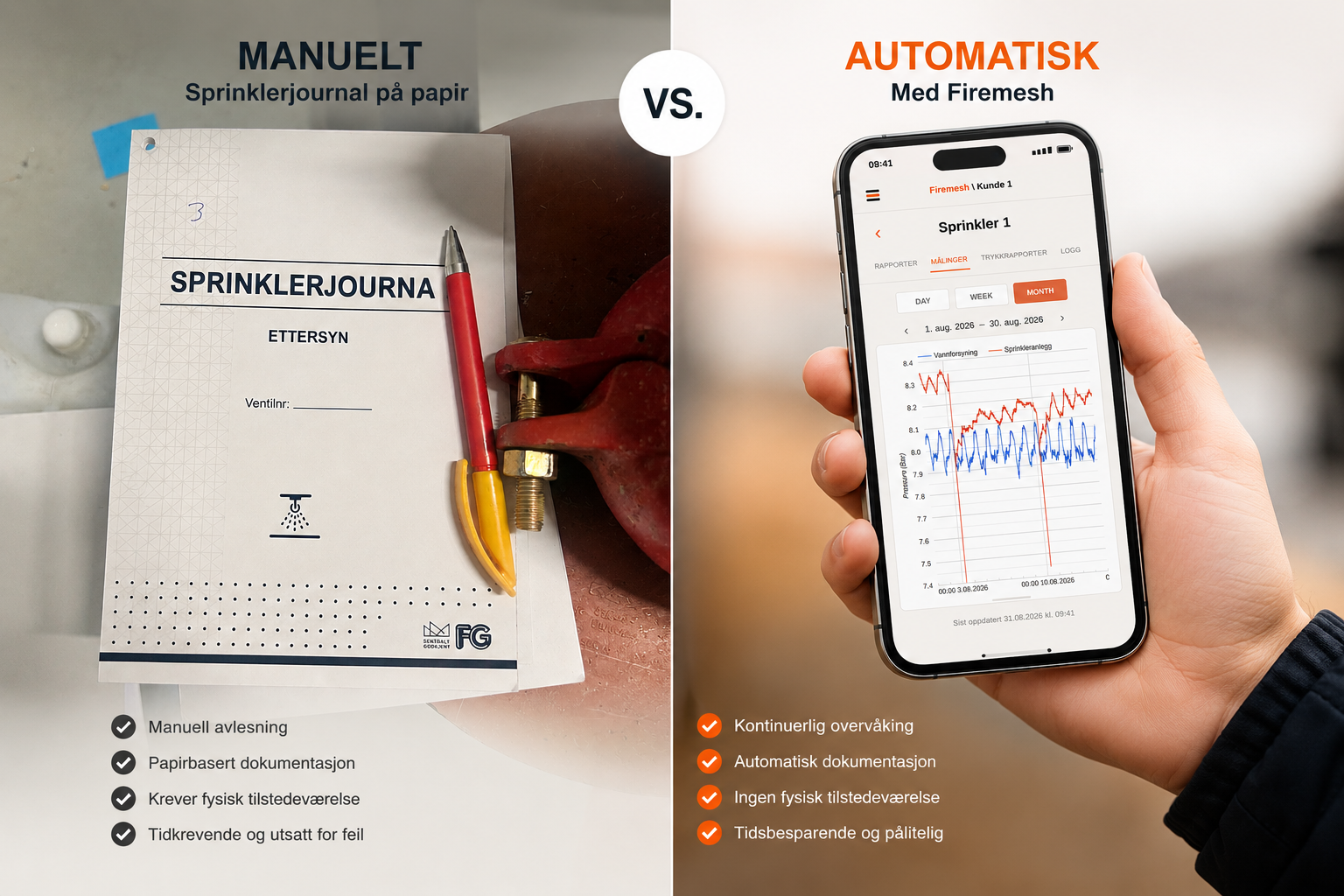
Firemesh is built around the core insight that reliability statistics give us: it is not the technology that fails — it is the interval between inspections that is too long.
- Continuous monitoring detects whether the system has been switched off — not once a week, but immediately
- Automatic alerts ensure the responsible person is notified the moment something deviates
- Digital log provides documentation you can present at audit or in an insurance claim
- History and trends let you identify if the same checkpoint is causing repeated problems
The goal is straightforward: ensuring your system always sits in the part of the statistics where sprinklers actually work.
→ See how Firemesh monitors your systemFrequently Asked Questions
How reliable are sprinkler systems?
Well-maintained systems work in 90–99% of cases internationally. Norwegian figures are likely lower, given that the inspection regime is weaker than in comparable countries.
What is the most common reason sprinklers fail to activate?
The system being switched off — this accounts for approximately 73% of all failure cases. It is not a technical fault, but a process failure that weekly inspection would have caught.
Does the number of activated heads indicate whether a system worked?
No. Research shows this is an unreliable measure. A system can activate many heads and still have functioned correctly — or activate few and still have failed to perform as intended.
Are Norwegian sprinkler systems as reliable as those in the US or Sweden?
There is no robust national data for Norway. Based on the OFAS report from 2003 and a weaker inspection regime, there is reason to believe the average condition is worse than in those countries.
Can international study figures be trusted?
With caveats. The RISE report cautions against direct cross-country comparison because definitions and data collection methods vary significantly. Use the figures as indicators, not precise estimates.
What does continuous monitoring add over weekly inspection?
It reduces the detection window from seven days to seconds. If the system is switched off — the most common single cause of sprinkler failure — it is detected immediately rather than up to a week later.
Source: RISE Fire Research, report A19 20412:1 "Requirements for inspection and reliability of sprinkler systems", 2019. Commissioned by Firemesh AS.