Brannsikkerhet
Weekly Sprinkler System Inspection Is Not a Recommendation. It Is a Requirement.

Tahani Berge
The Short Answer
NS-EN 12845 requires sprinkler systems to be inspected at intervals of no more than seven days, and a log must be maintained documenting the inspections. Responsibility lies with the building owner and cannot simply be transferred. In practice, these inspections are often not carried out, and when they are, they are rarely documented in a way that stands up to an inspection or an insurance claim.
This is not our claim. The person responsible for fire safety at the Norwegian Building Authority has publicly confirmed that the required self inspections are not being carried out as required by regulations.
The most important point to take away: Missing or undocumented inspections are themselves a deviation, regardless of whether the system actually works.
Three Terms That Are Often Confused
The guidance to the Regulations on Fire Prevention distinguishes between three different activities. This distinction is worth noting, because it is the first link, not the second, that tends to fail in practice.
| Term | What it is | Who | How often |
|---|---|---|---|
| Inspection | A simple self check to ensure that functionality has not been weakened by operational changes or faults that have occurred after installation | Owner or facility manager | Weekly |
| Control | Examination of whether the installation complies with requirements documents and the design specification | Certified third party | Annually |
| Maintenance | Servicing, repairs and correction of deviations | Personnel with relevant technical competence or authorization | As required |
Most building owners have a good system for the annual control. It is ordered, invoiced and filed away. The weekly inspection has no equivalent mechanism. That is what makes it the weak link.
Where the Requirement Actually Comes From
The requirements stem from two legal frameworks that meet during the operational phase of a building: the Planning and Building Act and the Technical Regulations govern what is to be built, while the Fire and Explosion Prevention Act and the Regulations on Fire Prevention govern how the building is to be operated.
| Legal basis | What it requires |
|---|---|
| Fire and Explosion Prevention Act § 6 | Owners and users must keep safety installations in proper condition and ensure that they function as intended at all times. It is not sufficient for the system to have worked during the previous annual inspection. |
| Fire and Explosion Prevention Act § 8 | Requires systematic HSE work. Compliance must be documentable to the supervisory authorities. Undocumented compliance is, in practice, a lack of compliance. |
| Fire and Explosion Prevention Act § 19 | Safety considerations must be integrated into all phases of the organization's activities. The obligation lies explicitly with management. |
| Regulations on Fire Prevention § 5 | The owner must ensure that installations designed to limit the consequences of fire are controlled and maintained so that they function as intended. |
| Regulations on Fire Prevention § 9 | The organization must have procedures for identifying, correcting and preventing deficiencies, creating a structure that prevents random errors. |
| TEK17 § 11-12 | Requirements for automatic fire extinguishing systems in risk classes 4 and 6. Hotels are classified as risk class 6. |
| TEK17 § 4-1 and PBA § 21-10 | Requirements for documentation during the operational phase, providing the basis for how operation and maintenance are to be carried out. |
The Standard Is Not a Law, but It Defines the Performance Level
NS-EN 12845:2015+A1:2019 is the main European standard for sprinkler systems. It is not, in itself, legally binding. The legal requirements follow from the laws and regulations above, while the standard describes how those requirements are met in practice.
The distinction has a practical consequence: TEK17 refers to the standard, and a system that follows it is considered to comply with the regulatory requirements. Deviations from the standard must be separately justified and documented.
What the Weekly Inspection Actually Covers
Chapter 20.1 requires the user to appoint a responsible person and a deputy who, following training, are responsible for ensuring that the system remains in working order. A log must also be maintained and kept on the premises.
Chapter 20.2.2 lists what must be carried out at intervals of no more than seven days:
- Checking and recording all water and air pressure gauges on installations, the main water supply and water tanks.
- Checking that the main control valve is in the correct position.
- For dry and pre action systems: checking that the air pressure in the pipe network does not fall by more than 1.0 bar per week.
- Testing water alarms for at least 30 seconds.
- Testing that the fire water pumps start automatically by reducing the water pressure at the starting device to simulate an activated sprinkler head. The starting pressure must be checked and recorded.
- For diesel pumps: checking fuel and lubricating oil levels, oil pressure, engine temperature, coolant flow, oil hoses and leaks, as well as carrying out the manual start procedure after 20 minutes of operation.
- Checking any heating systems intended to prevent freezing.
By comparison, battery condition must be checked monthly (Chapter 20.2.3), while control valves, alarms and backflow prevention devices must be checked and, where necessary, replaced every three years (Chapter 20.3.5.3).
This must be done 52 times a year. Every year. Without fail.
Four Areas of Exposure With Current Practice
These are independent of one another. You can be exposed on all four fronts even when the system has no technical faults.
Exposure 01: Failure to meet the inspection requirement
An inspection that is not carried out within seven days is a deviation from NS-EN 12845 Chapter 20.2 and therefore from the Regulations on Fire Prevention § 5. The deviation exists regardless of whether the system actually works.
Exposure 02: Missing documentation
The standard requires a log to be kept on the premises. FG-920 requires documentation of completed inspections to be available during control. The Fire and Explosion Prevention Act § 8 requires compliance to be documentable. A log that does not exist is, in practice, an inspection that has not been carried out.
Exposure 03: Insurance exposure
Deviations are recorded during FG controls, which insurance companies use in their risk assessments. Failure to comply with safety regulations may affect an insurance settlement following a fire. Finance Norway has worked to link the sprinkler system register more closely with insurance companies, meaning that missing controls could have a direct impact on premiums.
Exposure 04: Management responsibility
The Fire and Explosion Prevention Act § 19 places the obligation explicitly on management. In the event of a serious incident, it is management's systems and procedures that will be subject to scrutiny, not whether an individual caretaker remembered to go down to the technical room.
Why Weekly Inspections Fail
The reasons are well known and not particularly dramatic, which is precisely the point: this is a system weakness, not a personnel problem.
A master's thesis from the University of Stavanger, referenced by RISE Fire Research, points to insufficient or absent training, users who do not understand their responsibilities, a lack of understanding of the consequences of faults, inadequate internal control systems, and the fact that failure to correct faults rarely has consequences.
There is also the practical side. The inspection is repetitive work that must be carried out 52 times a year, in a technical room, by personnel who have many other responsibilities. There is also a real concern about doing something wrong with a pressurized system.
What the Numbers Show
| Finding | Source |
|---|---|
| In 73% (± 23) of cases where the sprinkler system failed to activate, the reason was that the system had been disconnected. Lack of maintenance was a direct cause in 10%. | Frank et al., cited in RISE report A19 20412:1 |
| Well maintained systems have reported effectiveness of 90–95%, with figures ranging from 70% to 99.5% depending on the definition used. | Frank et al. / RISE |
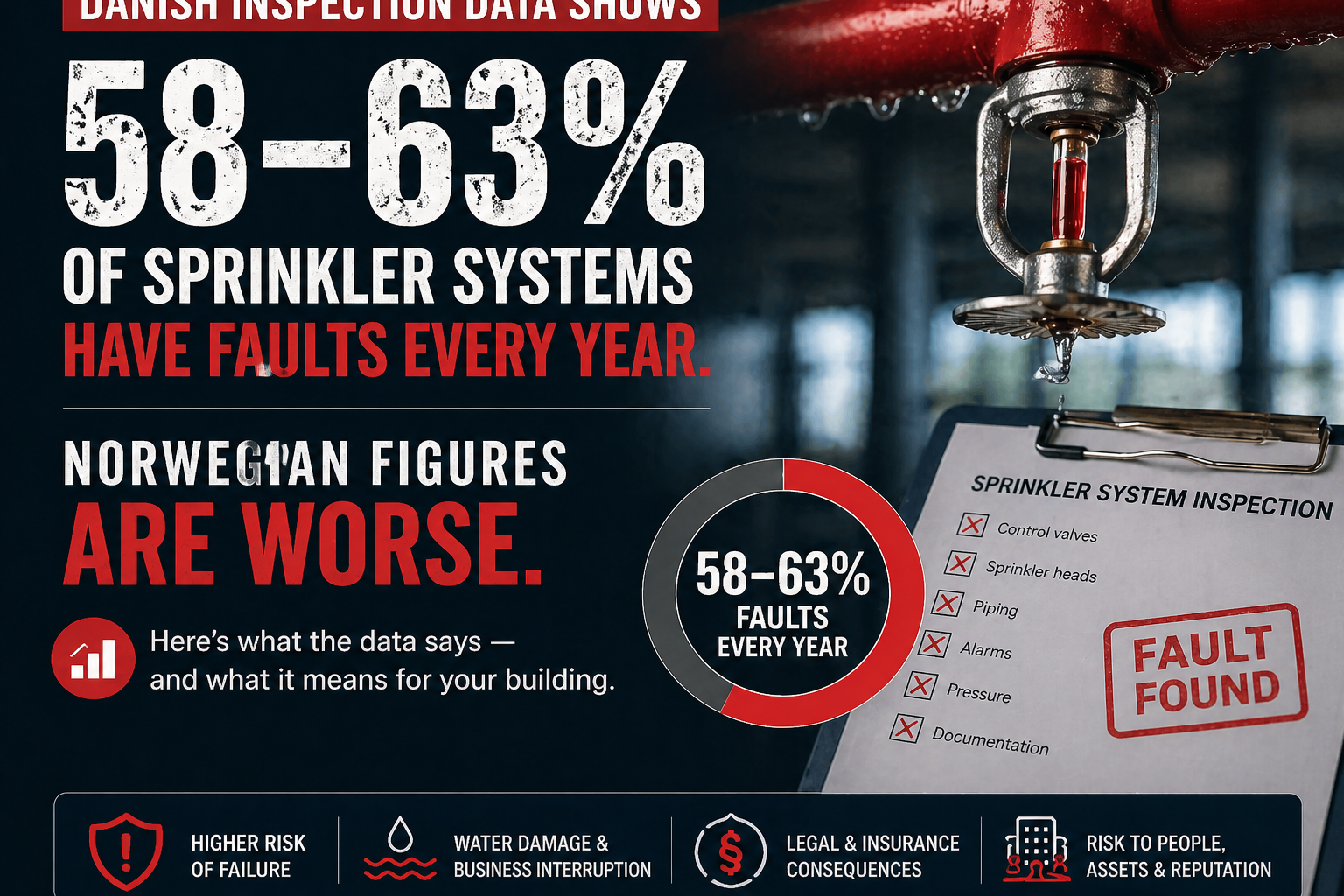
| More than half of all inspected systems had faults. Between 2.4% and 6.6% had deficiencies so serious that they could not be expected to handle a fire. | DBI, periods 2007–2011 and 2015–2016 |
| 33% of the systems examined had not carried out inspections. 60% had not corrected all faults following independent control. | OFAS (2003) |
| The required self inspections are not being carried out in accordance with applicable regulations and requirements. | Trond Andersen, responsible for fire safety, Norwegian Building Authority |
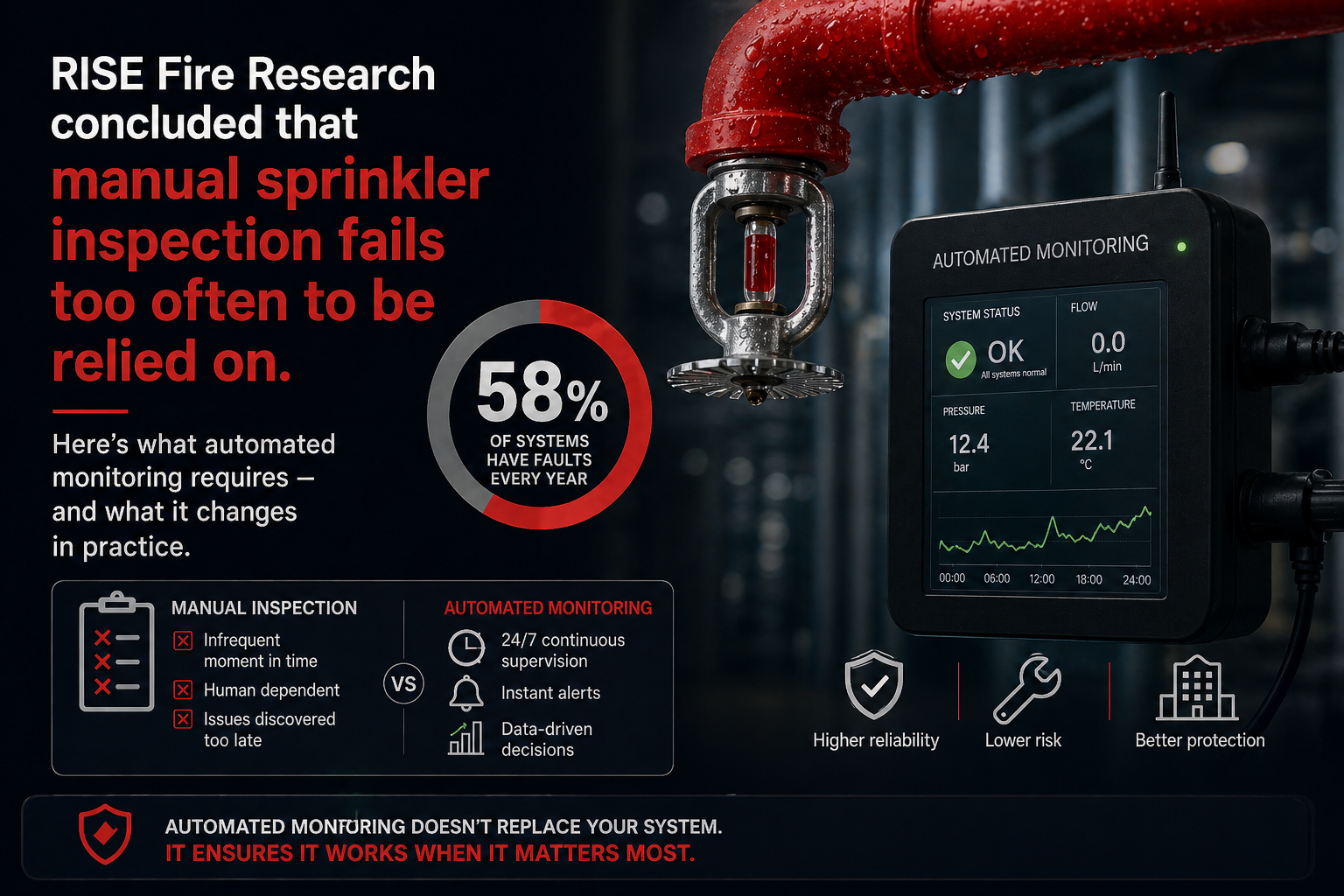
RISE emphasizes that international sprinkler reliability statistics are difficult to compare directly because definitions and data collection methods vary between countries. We present these figures with that caveat. The overall direction is nevertheless clear, and RISE's own conclusion is clear: a large proportion of the faults that cause systems to fail could have been detected through inspection.
The Problem No Annual Control Can Solve
Even a perfectly executed third party control has a fundamental limitation.
When the inspector discovers that a control valve is closed, nobody knows how long it has been that way. One day, or three hundred and sixty.
The current inspection and control regime can, at best, reveal that the system does not work. It cannot document that it has worked.
For a property portfolio, that is the difference between hoping the system worked on the night of a fire and being able to document that it did.
What Does FG Say About Automated Inspection?
This is an area where it is easy to oversell, so we answer without reservation.
FG currently has no dedicated certification scheme that "approves" automated inspection as such. There is no FG certification mark to refer to for this product category, and we do not claim to have one.
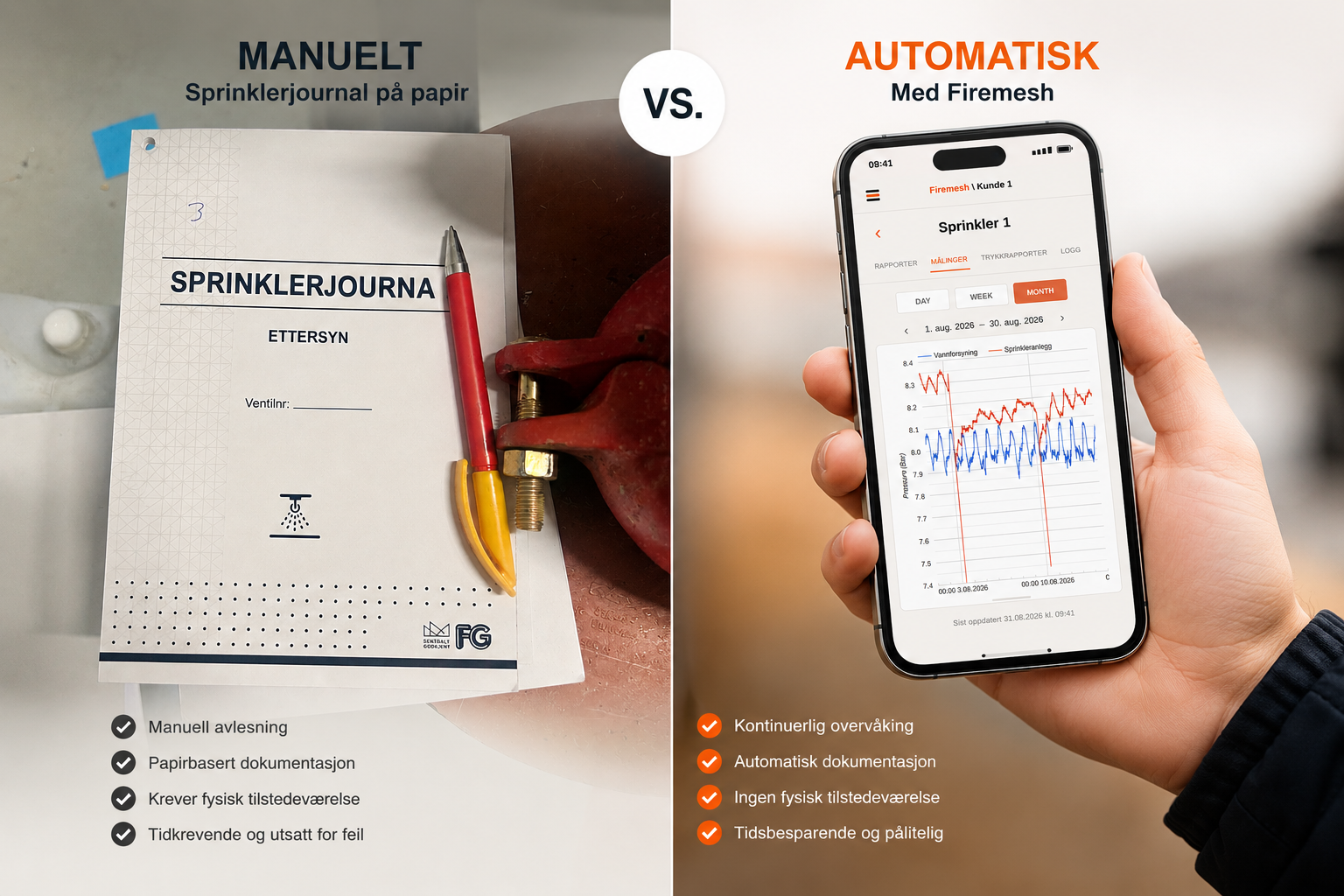
What FG does require is that documentation of completed inspections is available during control, and that alarm functions work and can be tested. That is exactly what a digital log and a monitored system provide, and in many cases more effectively than a handwritten logbook.
NS-EN 12845 Chapter 20 places responsibility for the inspection program on the user and requires a log to be maintained. The standard does not prescribe that a person must physically go to the valve. It specifies what must be checked, how often it must be checked, and that it must be documented.
Our recommendation to building owners: raise the FG question with the inspector on a pilot installation before rolling the solution out across a portfolio, so that the inspector's acceptance of the documentation format is clarified in writing.
What Automation Covers, and What It Does Not
An honest review of the weekly inspection, point by point. A supplier claiming that everything can be automated has not read the standard carefully enough.
| Requirement in Chapter 20.2.2 | Coverage | Comment |
|---|---|---|
| Checking and recording water and air pressure | Full | Measured continuously, not just weekly. Trends and historical data are stored. |
| Main control valve in the correct position | Full | Continuously monitored. A B alarm is triggered if the valve is closed, so the issue is detected immediately rather than up to a week later. |
| Pressure drop in dry/pre action systems (max. 1.0 bar/week) | Full | Continuous measurement provides earlier notification than weekly readings. |
| Water alarm test for at least 30 seconds | Full | Included in the automatic test sequence, with the result recorded. |
| Automatic pump start following pressure reduction | Partial | Depends on pump type and system configuration. Clarified for each building during the assessment. |
| Diesel pump: fuel and oil levels, oil hoses and leaks | Manual | Physical inspection is still required. Applies only to systems with diesel driven pumps. |
| Checking frost protection/heating system | Partial | Can be monitored where a temperature sensor is included in the installation. |
| Logging, stored on the premises (Chapter 20.1) | Full | Digital logbook, available to the FG inspector and service inspector, and presentable during inspections. |
| Annual third party control (Chapter 21) | Not covered | Must still be carried out by a certified FG inspector. Firemesh makes the control easier, not redundant. |
Important limitation: Automated inspection does not replace the annual third party control. Chapter 21 remains unchanged. What Firemesh replaces is the weekly self inspection under Chapter 20.2, the task that currently falls to operational personnel and is the one that fails in practice.
The Direction in Europe
NS-EN 12845 is the Norwegian edition of the European EN 12845 standard, and the same requirements for weekly inspection apply throughout the EU/EEA. What varies is the control regime surrounding them.
The Netherlands has a stricter system than Norway: sprinkler systems are regulated through the CCV certification scheme for VBB installations, with accredited inspection bodies issuing inspection certificates. Where a sprinkler system is used as an equivalent solution to a building regulation requirement, the system must always have an inspection certificate.
Denmark has a stricter sanctions regime: systems can lose their approval if serious faults are not corrected within the specified deadline. RISE points out that this is likely one reason why the fault rate is lower in Denmark, and that Norwegian systems may be assumed to have a higher proportion of faults than the Danish figures indicate.
Documentation requirements across Europe are becoming stricter, not less strict. A portfolio with a digital, auditable log is better prepared for that development than a portfolio with paper folders in technical rooms.
→ See how Firemesh covers the weekly inspection in your building
Frequently Asked Questions
Is weekly inspection really a legal requirement, or merely a recommendation?
It is a binding requirement. The obligation follows from the Fire and Explosion Prevention Act § 6 and the Regulations on Fire Prevention § 5, with NS-EN 12845 Chapter 20 providing the performance level that describes how the obligation is fulfilled.
Can responsibility be transferred to a service provider?
No. The task can be outsourced, but responsibility remains with the owner and, under § 19, explicitly with the organization's management.
What if the system works, but the log is missing?
There is still a deviation. § 8 requires compliance to be documentable to the supervisory authorities, and FG-920 requires the documentation to be available during control.
Is automated inspection FG approved?
FG currently has no certification scheme for this product category. What FG requires is that documentation is available and that alarm functions can be tested. Clarify the documentation format in writing with the inspector on a pilot installation.
Does automated inspection replace the annual control?
No. The Chapter 21 control must still be carried out by a certified third party. Automation covers the weekly inspection between controls.
What is the single most important benefit?
Detecting that the system has been disconnected, the most common cause of sprinkler system failure in a fire, within seconds instead of up to seven days later. And having the log that proves it afterwards.
Sources: NS-EN 12845:2015+A1:2019 · Brann- og eksplosjonsvernloven §§ 6, 8 og 19 · Forskrift om brannforebygging §§ 5 og 9 med DSBs veiledning (2016) · TEK17 §§ 11-12 og 4-1, PBL § 21-10 · NS 3960:2019 · FG-910, FG-920:5 og FG-930:1, Finans Norge Forsikringsdrift · Bøe, A.S. og Sesseng, C. (2019): Krav til ettersyn og pålitelighet til sprinkleranlegg, RISE Fire Research, rapport A19 20412:1, utarbeidet på oppdrag fra Firemesh AS · Frank, K. et al. (2013), DBI (2012/2017) og Adolfsen, T.Kr. (2003), alle gjengitt i RISE-rapporten.